
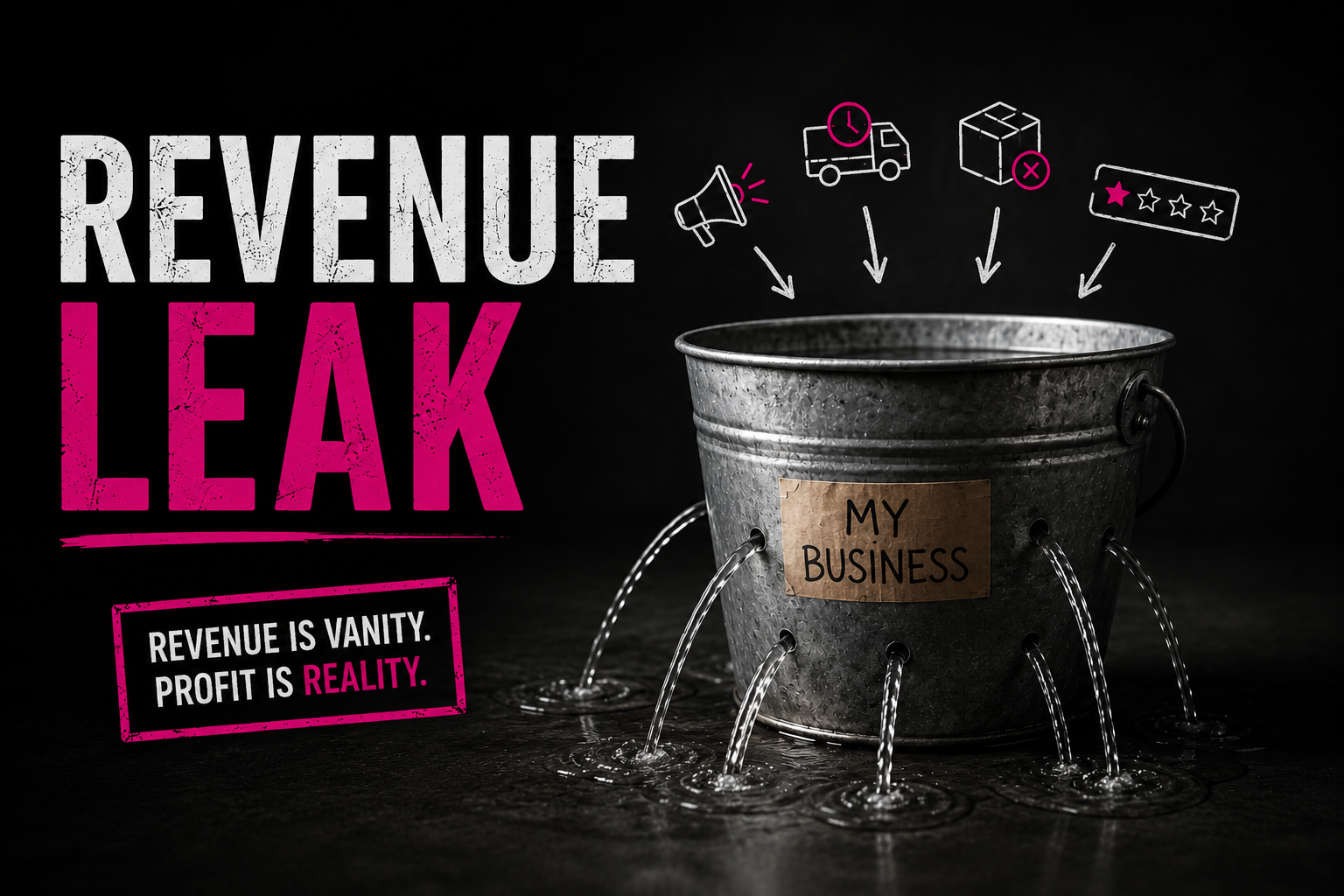
#002. Why Chasing Revenue Keeps You Broke: PROFIT Sets You Apart
Hi there, it’s Rebecca.
I’ve experienced both sides of ecommerce revenue.
My premium silk scarf store gave me my first €1,000 day. It was also the first real proof that premium positioning, healthy margins and the right offer could create a business model that worked.
But I’ve also built low-ticket stores where the sales dashboard looked active while advertising costs, supplier invoices, shipping, transaction fees, apps and returns ate through the money coming in.
The difference wasn’t simply revenue.
It was what remained after making the sales.
If you’re generating orders but still wondering where all the money went, I know exactly how that feels.
Social media trains us to obsess over revenue. We see the screenshots, dashboards and claims of “$10k days” and “$100k months.” They look impressive and create a beautiful illusion of success.
But revenue without context tells us very little.
Revenue is noise. Profit is signal.
Revenue tells you how much money passed through the store. (Often referred to as revenue generation). Profit tells you whether the model actually worked.
That lesson changed the way I judge every product, offer and store I build.
What the Numbers Actually Mean
It took me far too long to stop looking at the number at the top of the dashboard and pay attention to what was left at the bottom.
Here is the simple reality:
📦 The Margin Reality Check
- Revenue: The total value of your sales before any costs are deducted. This is the number people flash online. It is not your take-home money.
- Gross Profit: What remains after subtracting the direct costs of producing, buying and delivering the products you sold.
- Net Profit: What remains after subtracting the other costs of running the business, including advertising, software, transaction fees, returns and operating expenses.
It is entirely possible to build a high-revenue store that leaves you exhausted, cash-poor and wondering why you are working so hard.
I know, because I have built stores that generated sales while returning far less than the dashboard suggested.
The Revenue Trap I Fell Into
I did what many store owners do when the numbers weren’t working.
I tried to sell more.
More products. More advertising. More orders. More volume.
But scaling a weak-margin model doesn’t fix it. It magnifies everything that is already wrong.
As volume grows:
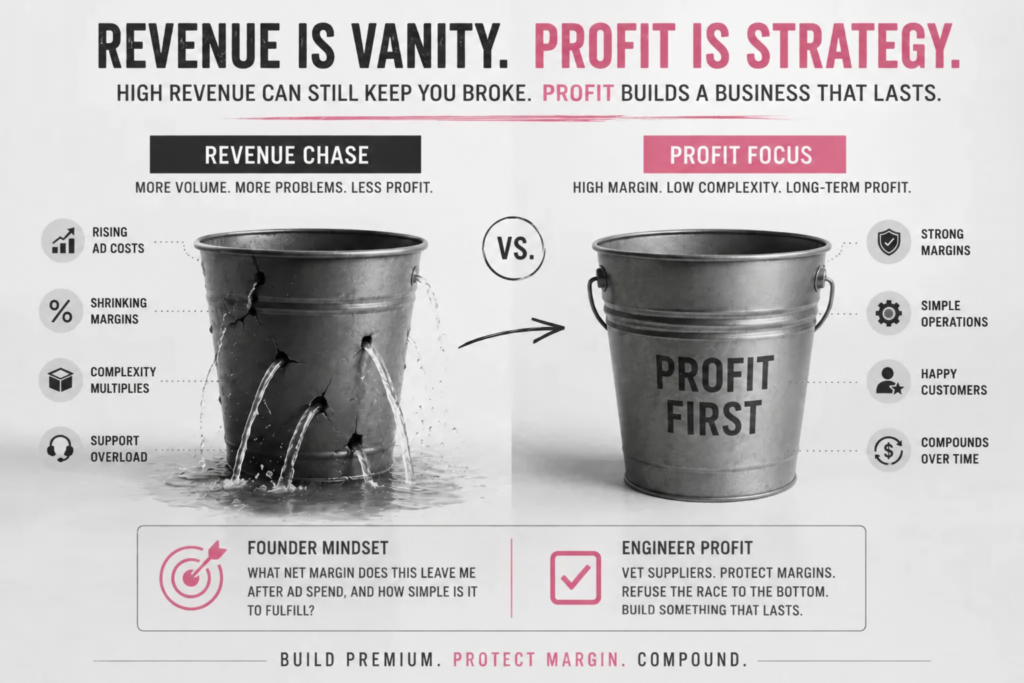
- Advertising costs increase
- Margins come under more pressure
- Returns and chargebacks increase
- Logistics become more complicated
- Customer support volume explodes
- Complexity multiplies
The dashboard gets busier. You get busier. But the business doesn’t necessarily become stronger.
I found myself working harder, committing more money and taking on more complexity without creating the financial return that should have come with it.
That is the revenue trap.
You believe the next level of sales will solve the problem, when you may simply be scaling the leak.
What Profit Changed for Me
Today, when I assess a product or business model, I no longer begin with:
How many could I sell?
I begin with:
What will remain after the real costs of making that sale?
Profit gives a business breathing room.
- It absorbs fluctuations in advertising costs
- It stabilises operations
- It gives you more control
- It allows you to reinvest
- It helps the business survive difficult months
- It gives your work a financial purpose
Revenue is vanity. Profit is strategy.
Let’s look at a quick visual comparison so you never unsee it :)…
The Margin Edge You Need Today
What I experienced is one of the reasons I created The Founder’s Margin™.
The principle is simple:
High margin + low complexity = long-term profit.
Margin-first store owners don’t chase volume for the sake of seeing a larger dashboard number. They protect what remains.
That means choosing premium products, simplifying logistics, developing strong supplier relationships and building deeper customer relationships.
I had to stop thinking like someone chasing the next transaction and start thinking like someone building a valuable asset.
- Transaction seeker: “How many sales can I get from this trending product today?”
- Founder mindset: “What net margin will this product leave after advertising, and how simple will it be to fulfil?”
Founders engineer profit.
They question the numbers, vet suppliers carefully, protect margins fiercely and refuse to sell generic rubbish that forces them into a race to the bottom.
When you build profit first, you give yourself the margin to outlast competitors, reinvest strategically and grow without adding endless chaos.
Because the number that matters isn’t how much money moved through your store.
It’s what remains after everything else has taken its share.
So the next time you see a revenue screenshot flex online, remember – it tells you nothing about the profit or success of the business.
Hang in.
Build Premium. Protect Margin. Compound.
See you next Saturday…
Rebecca
P.S. Next Saturday, I’m taking this profit-first mindset one step further. I’ll show you how to stop “renting” your business and map the path from raw dropshipping to building a high-margin asset you actually own. Keep an eye on your inbox.
If you liked the above, you might also like:
#003. The Control Edge: Build an Ecommerce Business You Actually Own
#008. The Supplier Edge: How Strong Partnerships Protect Your Ecommerce Margin
#009. The Premium Margin Edge: Build More Profit With Fewer Orders