#007. The AI Edge: Build a Better Ecommerce Brand With Less Complexity
Reading Time: 4 minutes
Hi there, it’s Rebecca.
I built ecommerce stores long before generative AI became part of everyday business.
Product research, competitor analysis, website copy, customer emails and product images all required considerably more time and manual work than they do today.
Now, many of those tasks can be completed in a fraction of the time.
I use AI every day. It helps me research faster, question my assumptions, organise information, improve my writing and remove repetitive work.
I find it extraordinary.
But I don’t use AI to replace my experience. I use it to get more value from the experience I already have.
That distinction matters.
Most store owners are asking:
“How can AI help me do more?”
I believe a better question is:
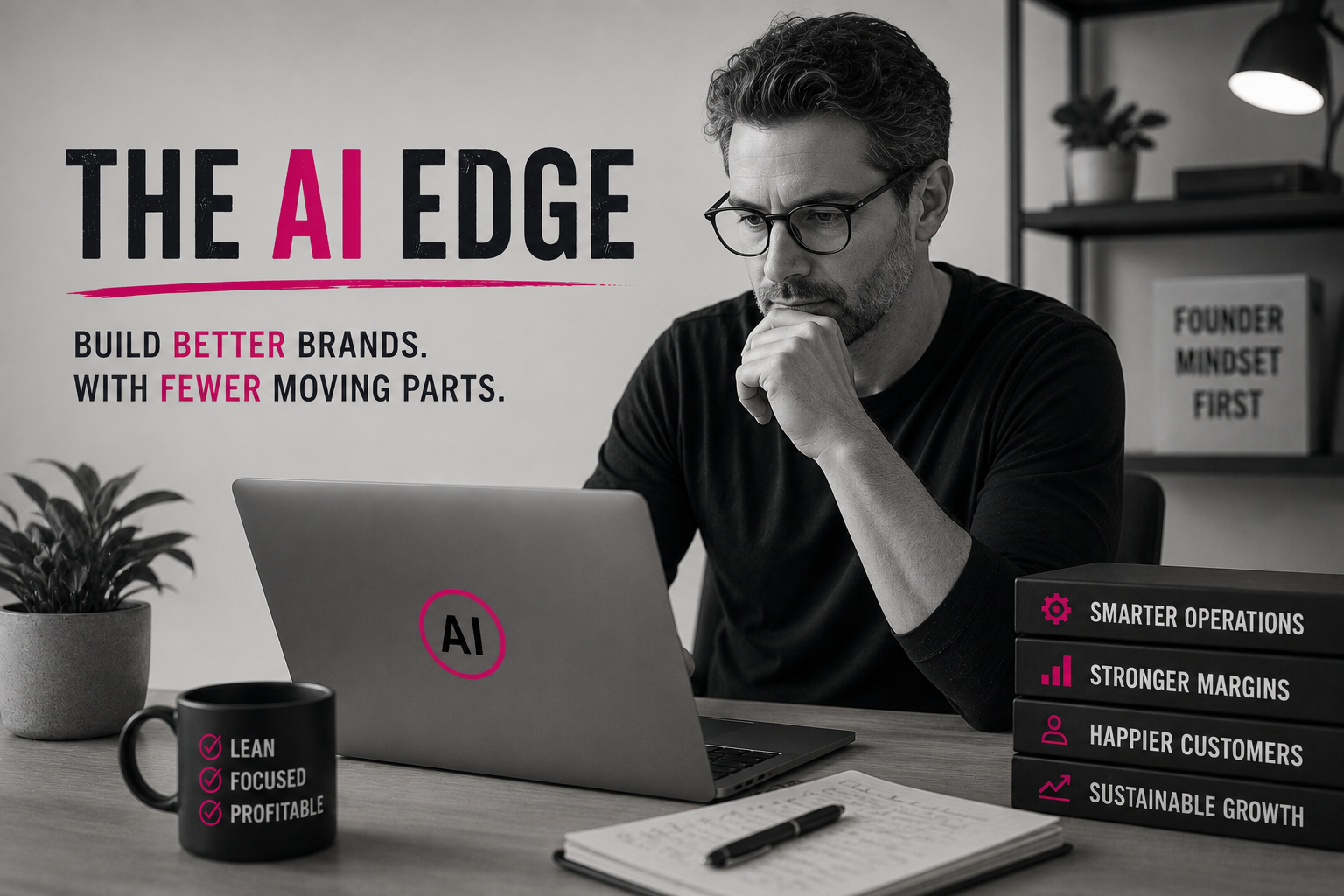
“How can AI help me build a stronger, more profitable ecommerce business with fewer moving parts?”
Because more output doesn’t necessarily mean more progress.
AI Amplifies What Is Already There
AI doesn’t magically fix a weak ecommerce business. It amplifies the business you have already built.
If your offer is strong, your product is excellent and your customer experience is carefully designed, AI can help you improve the operation and move faster.
But if the foundations are weak, AI can multiply those weaknesses too.
More traffic won’t fix a disappointing product. More content won’t create genuine differentiation. More automation won’t repair unreliable fulfilment.
And more AI-generated marketing won’t compensate for an offer customers don’t really want.
When you use AI simply to increase volume, you may create more customer support problems, refunds and operational complexity at greater speed.
AI can help you scale, but it cannot decide what is worth scaling.
That still requires human judgement.
The Production Mirage
There is nothing wrong with using AI to write product descriptions, draft emails, generate images or develop advertising ideas. I use it for many of those tasks myself.
The problem begins when production becomes the goal.
It is very easy to spend hours experimenting with AI tools and feel productive because you have created a huge amount of material. But has any of it made the offer better? Has it improved the customer experience or protected your margin?
Or has it simply created more output for you to manage?
I have no interest in using AI to produce generic content faster. I want it to help me think more clearly, test ideas intelligently and make better commercial decisions.
That is real leverage.
Never Ask AI to Invent Experience You Don’t Have
I use AI as a thinking partner, not as a substitute for expertise.
It can help me organise a lesson from one of my previous stores, challenge the structure of an argument or identify a question I may have overlooked.
But the underlying experience must be real.
The tea-supplier negotiation that saved me $600 happened. The silk-scarf supplier that closed during COVID was real. The ecommerce store that disappeared from my dashboard while I stood outside a restaurant in France was mine.
AI can help me communicate those lessons more clearly, but it cannot live them for me.
AI should never replace your judgement, experience or point of view. It should multiply them.
Without those things, AI simply makes it easier to sound like everybody else.
Use AI to Find the Leaks
One of the most valuable uses of AI isn’t creating more marketing. It is helping you understand what is already happening inside your business.
For example, you can use it to:
- Analyse customer reviews and identify recurring complaints
- Group support enquiries into common problems
- Compare supplier quotations and flag discrepancies
- Turn a repeated process into a clear operating procedure
- Summarise product feedback and uncover improvement opportunities
- Find where time, money and attention are being lost
This is where AI begins to protect your margin.
Instead of using it to answer the same customer complaint more quickly, ask it to help you understand why the complaint keeps happening.
Before generating ten new advertising angles, use it to investigate why the existing offer isn’t converting.
Don’t use AI only to create more work. Use it to remove work that shouldn’t be there.
What Would Happen If Your Orders Doubled?
Before using AI to increase demand, ask yourself one uncomfortable question:
If my orders doubled tomorrow, where would the business break first?
Perhaps your supplier couldn’t maintain quality. Your fulfilment process might struggle, delivery times could increase or your customer-support inbox might become unmanageable.
You also need to know whether your profit margin would remain healthy after the additional advertising costs, returns and refunds.
AI can help you explore these questions, examine the data and consider possible outcomes. But you still have to make the decision and act on what it reveals.
Growth exposes weaknesses. It doesn’t solve them.
Fix the leaks first. Then use AI to strengthen what deserves to grow.
The Margin Edge
A transactional store owner sees AI as a production machine.
A founder sees it as leverage.
Use AI to research faster, improve your decisions, remove repetitive work and identify expensive problems before they grow.
Keep your experience, judgement and standards firmly inside the process.
The goal isn’t to build a business filled with more AI. It is to build a better business with enough margin to protect your profit, time, energy and attention.
AI shouldn’t replace your expertise.
It should multiply it.
Build Premium. Protect Margin. Compound.
See you next Saturday…
Rebecca
If you liked the above, you might also like:
#008. The Supplier Edge: How Strong Partnerships Protect Your Ecommerce Margin
#004. The Ecommerce Evolution: From Dropshipping to a Minimum Viable Brand
#006. Escape the Dropshipping Trap: Build a Brand You Own