
#009. The Premium Margin Edge: Build More Profit With Fewer Orders
Reading Time: 5 minutes
Hi there, it’s Rebecca.
I learned about the Margin Mirage through a pile of returned cycling jerseys in my Swiss home.
One of my earlier ecommerce businesses was EZVelo, an online cycling-clothing store.
I entered an extremely competitive market and tried to win by undercutting everybody else. The strategy appeared to work. The jerseys sold like hot cakes, particularly in the Netherlands.
The order notifications kept arriving and the revenue looked exciting.
But low prices left very little room for anything to go wrong.
Once I deducted the advertising costs, there was hardly any profit left. Then the returns began arriving.
Cycling clothing is highly dependent on fit, and those returned jerseys gradually piled up in my home. I remember looking at them and wondering how on earth I was going to sell them all again.
I kept the ones in my size and still cycle in them today, so at least they found a good home! 🙂
But commercially, the lesson was painful.
The store was generating plenty of transactions without creating enough profit to justify the work, advertising costs and returns.
I had mistaken sales volume for a healthy business.
Welcome to The Margin Mirage.
It is the illusion that if you sell enough low-ticket products, the volume will eventually produce the income you need.
Often, the opposite happens.
The more you sell, the more parcels you fulfil, the more customers you support and the more returns you process, while remarkably little money remains for you.
A store can sell like hot cakes and still be a poor business.
The Three Margins You Need to Know
One of the most dangerous mistakes in ecommerce is using the word margin without being clear about which margin you mean.
If a product costs CHF 5 and sells for CHF 20, the CHF 15 difference is not your net profit.
You still need to account for the other costs of making that sale.
- Gross margin is what remains after the direct landed cost of the product.
- Contribution margin is what remains after the variable costs of each order, including advertising, shipping subsidies, payment fees and an allowance for refunds or returns.
- Net margin is what remains after the wider operating costs of running the business have also been paid.
Revenue is not profit. Gross profit is not net profit. And money passing through your checkout is not necessarily money you get to keep.
You cannot scale your way out of weak unit economics. You simply scale the loss.
That is the Margin Mirage.
The Numbers Scratched Into My Brain
Whenever I evaluate an ecommerce model, I work backwards from the income the business needs to produce.
Let’s use an annual operating-profit goal of CHF 150,000 as a simple illustration.
What might the business look like if it were built around stronger margins and fewer transactions?
| Measure | Illustrative target |
|---|---|
| Average Order Value | CHF 150 |
| Net operating margin | 30% |
| Profit per order | CHF 45 |
| Orders required annually | Approximately 3,334 |
| Average orders required daily | Approximately 9 to 10 |
For this illustration, the 30% margin is what remains after the ordinary costs of operating the business, before personal tax.
The figures are not a promise, and your own costs will be different.
But the model demonstrates something important:
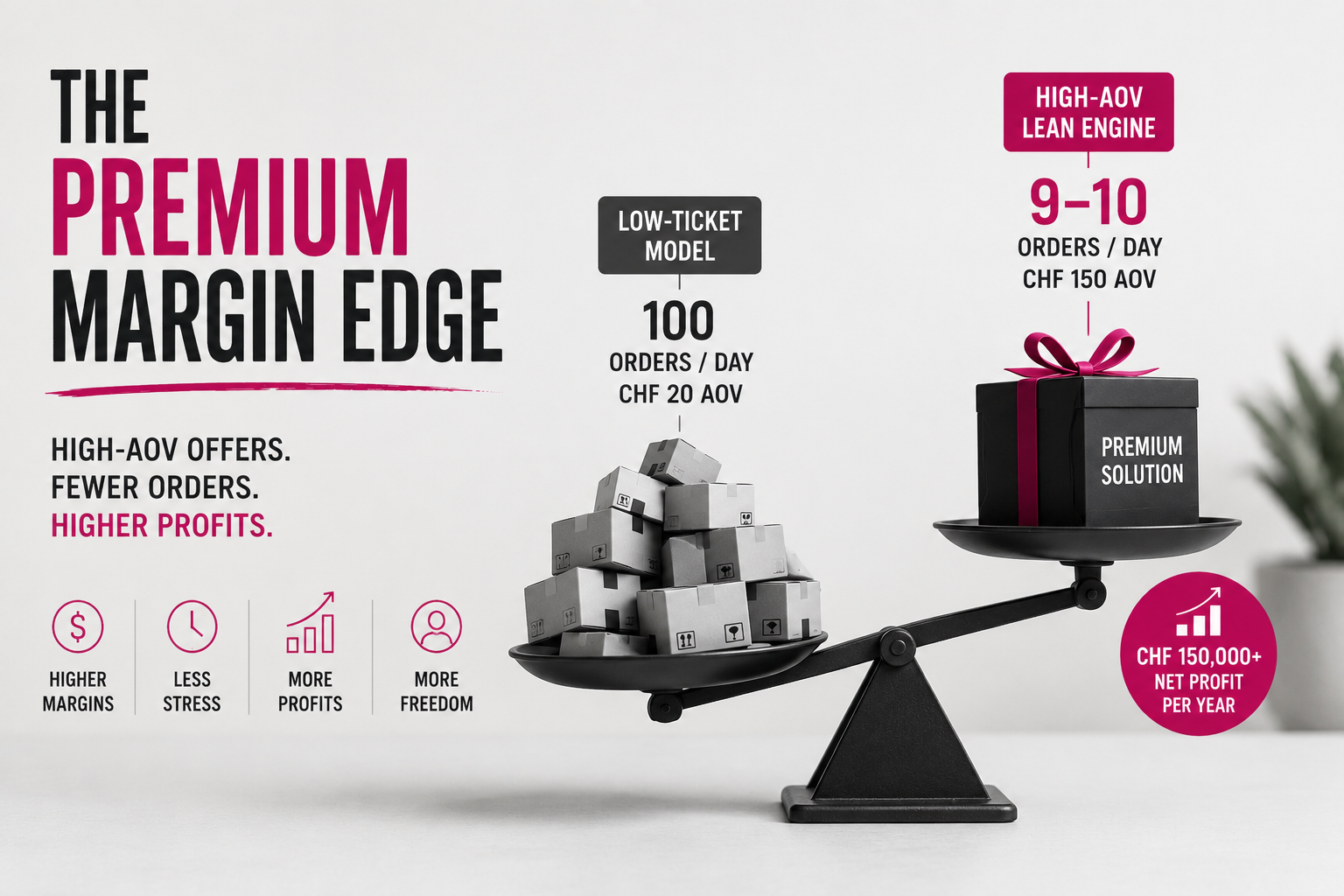
Replacing a good income does not automatically require hundreds of daily orders.
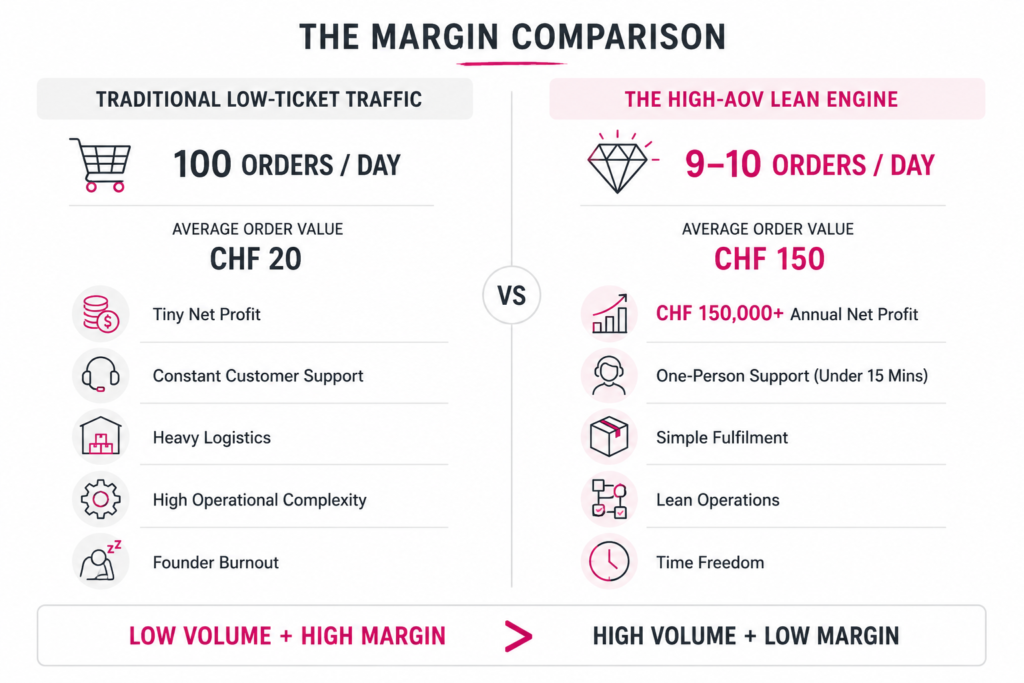
At CHF 45 profit per order, approximately nine to ten orders a day could produce around CHF 150,000 in annual operating profit.
Compare that with a low-ticket store making only CHF 5 per order. It would need around 82 orders every day to produce the same annual profit.
That is more than eight times the order volume.
More parcels. More payment transactions. More support enquiries. More opportunities for fulfilment mistakes, refunds and chargebacks.
Higher order volume can also require more staff, more systems and more of the founder’s attention.
A stronger margin gives you room to operate…
Premium Does Not Automatically Mean Profitable
I learned this through very different ecommerce businesses.
My premium silk-scarf store gave me my first €1,000 sales day. It showed me that customers would pay more for a product when the presentation, positioning and perceived value made sense.
Years later, my fine-jewewellery business taught me the other side of the equation.
The selling price was high, but so were the barriers.
Fine jewellery is deeply personal and highly subjective. Customers need considerable trust before buying from an unfamiliar brand. Compliance, capital requirements and the longer decision process added even more complexity.
It became a major wake-up call.
A high selling price does not automatically create an easy, high-margin business.
One of my later problem-solving bundles reinforced the lesson again. The offer converted, but customer acquisition costs left the net margin at around 10%.
There were sales. There was revenue. There was even proof that customers wanted the solution.
But there wasn’t enough margin for the risk, capital and work involved.
That is why I no longer ask only:
“Can I sell this at a premium price?”
I ask:
“After every cost and complication, does this offer leave enough margin to become a business worth running?”
Find the Premium Sweet Spot
Premium does not necessarily mean luxury, and it doesn’t mean charging an inflated price for an ordinary product.
A premium offer creates enough value for the customer to justify a stronger price while leaving enough margin for the business to deliver that value properly.
The strongest opportunities tend to combine several qualities:
- A clear and meaningful customer problem
- High perceived value relative to the delivery cost
- A price the customer can justify without an endless trust cycle
- Practical shipping and fulfilment
- Enough room for realistic customer-acquisition costs
- A customer experience worthy of the premium position
This is why a carefully constructed problem-solving bundle can be so powerful.
Instead of selling one generic product that customers can compare with dozens of identical listings, you create a more complete solution.
The customer sees greater value. Direct price comparison becomes more difficult. Average Order Value can increase without relying purely on volume.
But the bundle must genuinely improve the outcome. Adding cheap items merely to create the appearance of value is not premium positioning.
The offer needs to make more sense to the customer, not only produce a larger number in the checkout.
Margin Protects More Than Money
A stronger margin helps absorb rising advertising costs, unexpected refunds, supplier increases and difficult months.
It also protects the founder.
When you need fewer transactions to reach the same profit goal, the operation can become easier to understand and control. You have more time to improve the product, look after customers and make careful decisions.
That is the wider meaning of The Founder’s Margin.
Profit gives the business financial resilience. Operational margin gives you room to think. Time and attention give you the capacity to lead without allowing the business to consume your life.
Margin is not simply what remains after a sale. It is the room that allows the business and its founder to survive, adapt and compound.
The Margin Edge
Don’t begin by asking how many units you can sell.
Begin by understanding what one properly costed order leaves behind.
Calculate the landed product cost, customer-acquisition cost, shipping, payment fees, expected returns and the operational costs required to support the business.
Then ask whether the remaining margin justifies the capital, complexity and risk.
If it doesn’t, more advertising is unlikely to save you.
You may need to strengthen the offer, improve the positioning, increase the value, negotiate costs or choose a better opportunity.
The goal isn’t to charge the highest possible price.
It is to create a valuable offer with economics strong enough to support the customer, the business and the founder behind it.
Stop chasing impressive revenue.
Build an offer that leaves something valuable behind.
Build Premium. Protect Margin. Compound.
See you next Saturday…
Rebecca.