

#008. The Supplier Edge: How Strong Partnerships Protect Your Ecommerce Margin
Hi there, it’s Rebecca.
When most people start an ecommerce store, nearly all their attention goes towards the front end.
They search for a winning product, perfect the website, tweak their Meta ads and try to generate more sales.
I did plenty of that too.
But looking back over nearly thirteen years in ecommerce, I now see supplier relationships as one of the most overlooked competitive advantages in the entire business.
They can also become one of its most expensive leaks.
Many new store owners find a supplier on Alibaba or AliExpress, send a quick message, receive a standard quotation and accept it without examining what sits behind the numbers.
The relationship begins and ends with price. Quality is assumed. Communication happens only when something goes wrong.
I’ve learned to see suppliers very differently.
A good supplier is not a vending machine. They are a structural extension of your business.
Their pricing affects your profit margin. Their quality affects your reviews. Their reliability affects your inventory, customer experience and ability to sleep at night.
Choosing well gives your business more than financial margin. It creates operational breathing room too.
Negotiation Starts Earlier Than You Think
Real negotiation isn’t about aggressively arguing over every penny.
It begins with understanding your unit economics and asking better questions.
When I launched my tea business, I didn’t simply accept the factory’s first price for the custom pouches. The initial quotation was around $0.60 per bag.
I asked questions, discussed my projected order volumes and took the time to build a professional relationship. The price eventually came down to $0.30.
Thirty cents may not sound very exciting until you order 2,000 pouches.
That one conversation saved me $600 before I had sold a single packet of tea.
More importantly, that saving remained in the economics of every unit. As order volumes increased, the value of the negotiation increased with them.
That is why seemingly small supplier decisions can create significant margin over time.
Read Every Line of the Quotation
One habit I developed early was checking every quotation and invoice manually.
I look at the unit prices, quantities, packaging costs, shipping charges and final calculation.
You would be surprised how often something doesn’t add up.
Sometimes it is a simple clerical error. Sometimes a cost has been entered incorrectly. Sometimes the quotation leaves room for further discussion.
When I spot something, I reply politely:
“There seems to be an error in the calculation. Could you please check the quotation again?”
That isn’t being difficult. It is good commercial discipline.
Never assume a supplier’s calculation is automatically correct. Read the details, understand what you are paying for and ask when something doesn’t make sense.
Margin is often lost in the small lines nobody bothered to check.
The Supplier Dependency That Stopped My Scarf Store
I learned the danger of relying on one supplier through my silk-scarf business.
I had found a fantastic factory. The quality was excellent, the product imagery was beautiful and the relationship worked.
Because everything was going so well, I allowed that one factory to become irreplaceable.
Then COVID arrived.
The factory closed permanently and stopped restocking. I had no properly vetted alternative ready to take over.
That part of the business simply stopped.
It taught me something I have never forgotten:
A brilliant supplier can still be a single point of failure.
Today, I would never commit to a core product without first identifying at least three credible supplier options.
That doesn’t mean dividing every small order between three factories. It means knowing who your alternatives are, sampling their products and understanding whether they could step in if your primary supplier suddenly disappeared.
A backup you have never vetted is not really a backup.
Never Skip Sampling
Digital product photographs can make almost anything look premium.
The physical sample tells you the truth.
I have ordered products that looked excellent online but felt cheap when they arrived or failed under basic handling. No website design or clever marketing angle can compensate for a disappointing product.
Sampling also reveals far more than product quality.
It shows you how clearly the supplier communicates, how carefully they package an order, whether they meet the promised timeline and how they respond when you raise a concern.
Whenever possible, order samples from several suppliers at the same time. Products that appear identical online can vary enormously in materials, finish and overall quality.
This is not an unnecessary expense. It is an inexpensive way to avoid a far larger mistake.
Ask About What Happens Next
The best supplier questions don’t only concern today’s order. They help you understand what could happen if the offer works.
I want to know:
- How is quality control handled?
- What happens when products fail inspection?
- What are the realistic production and delivery times?
- Can the supplier add custom branding or packaging later?
- What happens if order volume suddenly increases?
- Can quality be maintained as production grows?
These questions matter before you scale, not after.
If an offer begins converting and the supplier cannot maintain quality or fulfil demand, you can lose stock, advertising momentum and customer trust remarkably quickly.
The right supplier should support the business you are trying to build next, not merely fulfil the order you are placing today.
The Margin Edge
Take an honest look at your current supplier setup.
Are you treating suppliers as anonymous vendors, or are you building professional relationships around quality, reliability and mutual trust?
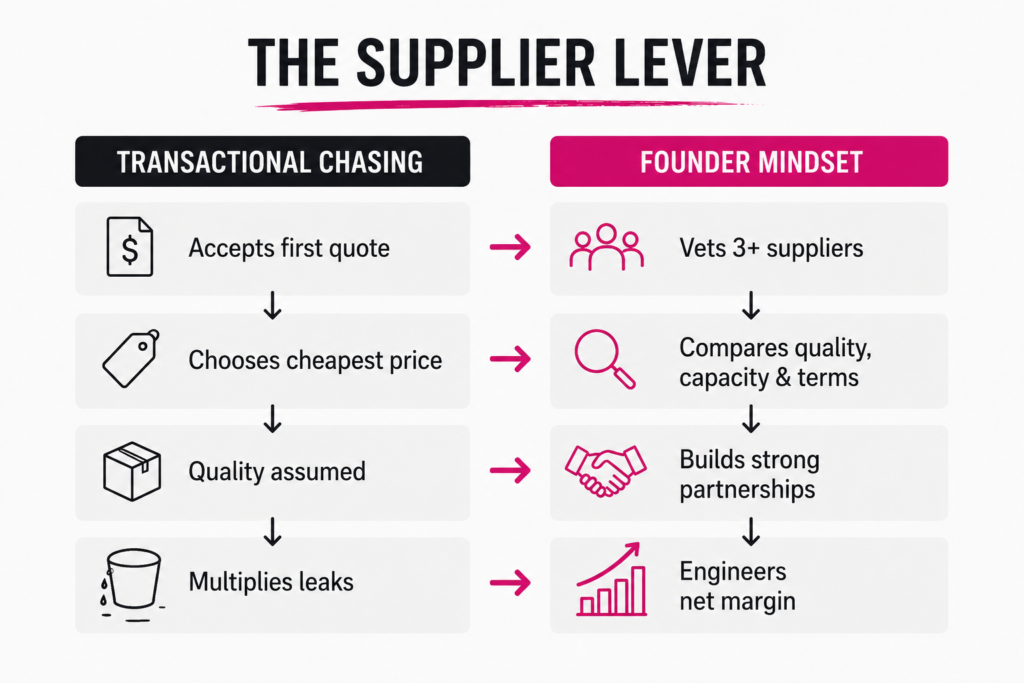
Transactional thinking accepts the first price, overlooks the calculations, skips proper sampling and allows one factory to become a critical point of failure.
Founder thinking compares carefully, asks precise questions, audits every quotation and builds alternatives before they are urgently needed.
The relationship works both ways.
Communicate clearly. Pay on time. Respect the supplier’s operational constraints. Be organised and professional.
When you become a reliable customer, a good supplier is more likely to prioritise your orders, flag potential problems early and work with you as the business grows.
Sometimes your greatest competitive advantage isn’t visible on your website.
It was created in a careful supplier decision made long before your first customer arrived.
Build Premium. Protect Margin. Compound.
See you next Saturday…
Rebecca.
If you liked the above, you might also like:
#009. The Premium Margin Edge: Build More Profit With Fewer Orders
#003. The Control Edge: Build an Ecommerce Business You Actually Own
#005. Founder Blind Spots: How Finding What You Miss Unlocks Real Growth