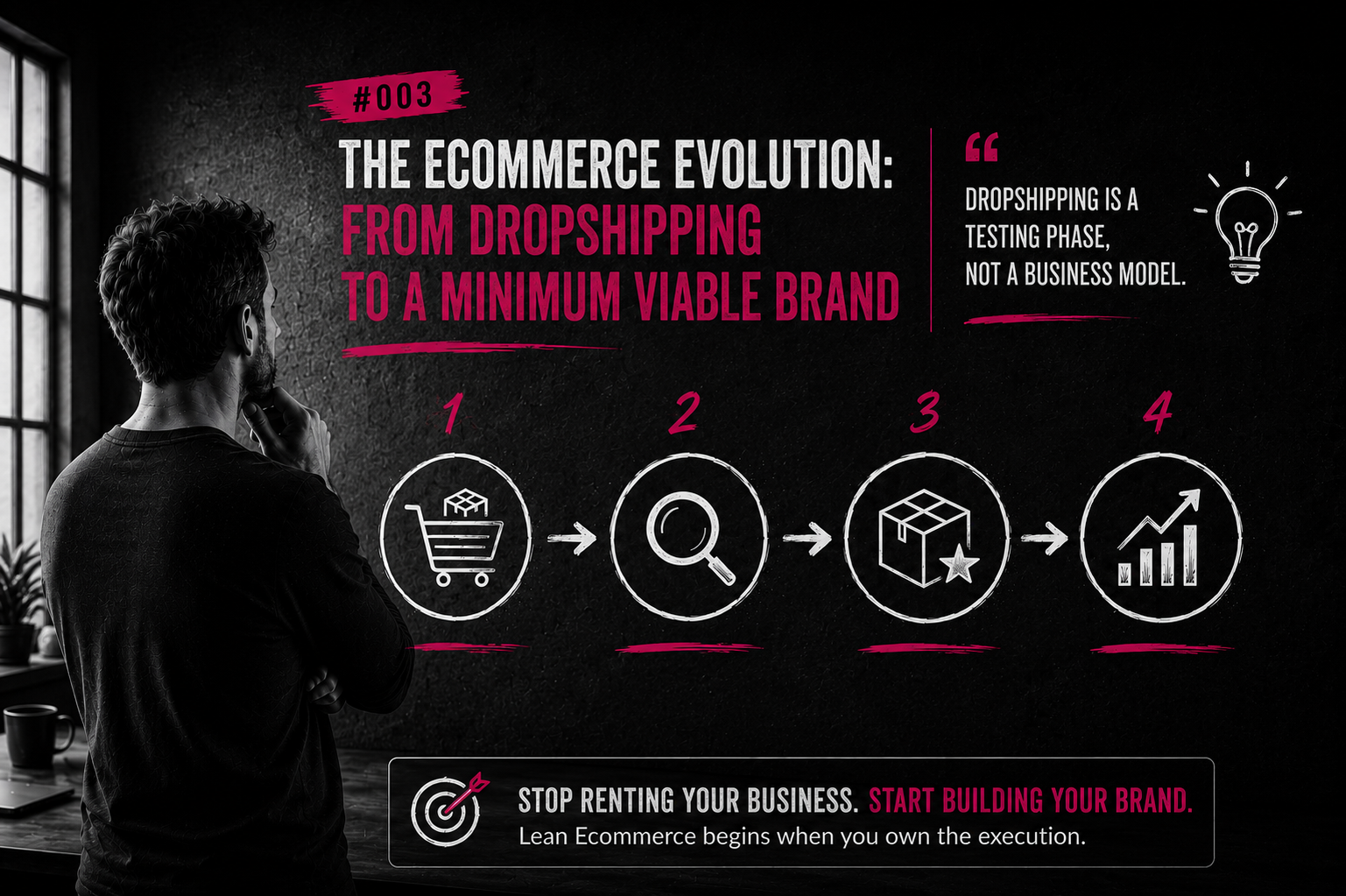
#004. The Ecommerce Evolution: From Dropshipping to a Minimum Viable Brand
Hi there, it’s Rebecca.
Most ecommerce store owners begin with dropshipping. It makes sense: it’s fast, low-risk and allows you to test an offer without committing thousands of dollars to upfront inventory.
It is a highly practical entry point.
But let’s be completely honest:
Dropshipping is a testing phase, not a permanent business model.
The biggest mistake I see folk make is sitting endlessly in the dropshipping stage.
They find a winner, increase their advertising spend, push volume and chase growth. But they never evolve to take control of the product, packaging or shipping times.
They try to sell these stores later, only to realise nobody wants to buy them.
Why?
Because there is very little market equity in a generic dropshipping store. You are renting the execution, not owning it.
The asset begins when you start taking control.
A margin-first ecommerce business begins when you stop treating dropshipping as the destination and use it for what it actually is: a resourceful laboratory for discovering your Minimum Viable Offer™.
Here is the evolution from renting a temporary store to owning a compounding asset.
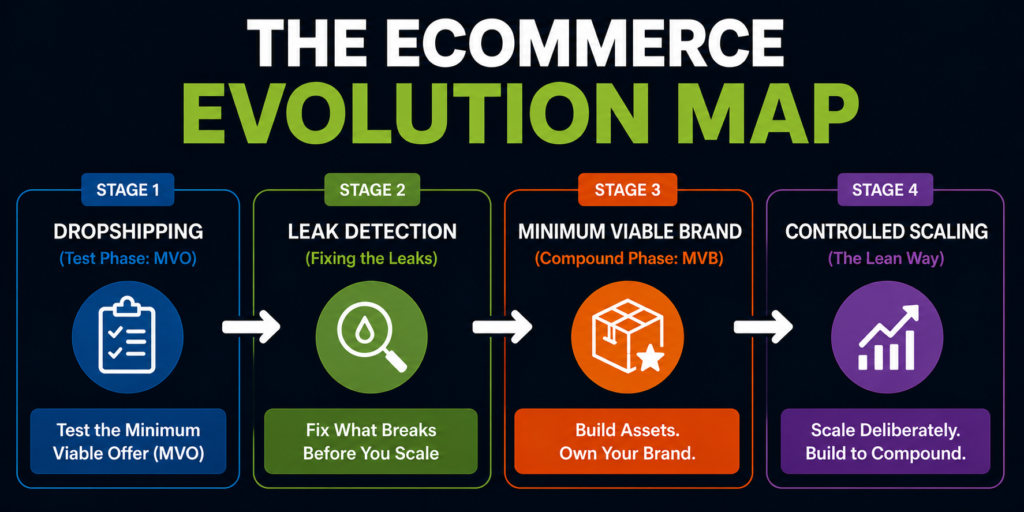
Stage 1: Dropshipping and the Minimum Viable Offer
In the test phase, dropshipping is useful for one specific purpose: validation.
You are resourcefully uncovering your Minimum Viable Offer™ by testing:
- Which audience, product and market fit exists
- Which marketing angles resonate
- Which positioning and bundled solutions create real customer momentum
This stage is intentionally temporary. Your goal is to find a conversion match without committing heavily to inventory.
Once you have consistent sales and initial cash flow, you do not simply scale the dropshipping operation.
You prepare to evolve it.
I’ll cover validation in more depth as this newsletter develops because dropshipping isn’t the only way to validate an offer.
Depending on the product and your financial position, you might use pre-orders or begin with a very small MOQ.
The key is to remain resourceful, no matter how much cash you have available.
Protecting capital preserves your financial margin for the opportunities that customers prove are worth pursuing.
Stage 2: Leak Detection Before You Scale
Validation is not permission to scale.
It is permission to inspect.
Before throwing more advertising spend at the offer, slow down and audit the friction points while the operation is still small:
- Refund patterns and quality complaints
- Supplier inconsistencies and hidden margin erosion
- Shipping delays and complicated logistics
Scaling a leaky business only multiplies the leaks.
Fix the foundational cracks before buying your way into a logistical nightmare.
This stage protects more than profit. It protects your time, energy and operational capacity before unnecessary complexity takes hold.
Stage 3: The Minimum Viable Brand
Once the leaks have been identified, you can begin moving out of dropshipping and into the compound phase.
This is where you build your Minimum Viable Brand™: the simplest, highest-control version of a credible ecommerce business.
Using the cash flow created during your testing phase, you begin to:
- Invest in small Minimum Order Quantities
- Improve product quality and customise the packaging
- Reduce shipping times and strengthen customer trust
This is often called private labelling.
I think of it as asset ownership.
You stop renting the entire execution from a third-party supplier and begin owning more of the product, customer experience, data and brand equity.
You also create more margin by improving supplier pricing, reducing fulfilment risks and building an offer that can command a premium price.
This is where a temporary store begins becoming a valuable business.
Stage 4: Controlled Scaling That Protects Margin
Founders don’t need to blow up a business overnight.
They scale through a deliberate sequence: increasing inventory gradually, watching customer feedback carefully and strengthening supplier relationships.
You increase your advertising spend when net margins are stable, logistics are predictable and repeat-customer systems are working.
Growth should strengthen the business, not consume all the financial and operational margin you worked to create.
Your Margin Edge
Most people try to jump directly from a random dropshipping winner to massive scale.
Then the business collapses under its own weight.
- Dropshipping discovers your Minimum Viable Offer
- Leak detection protects your margin
- The Minimum Viable Brand creates ownership and equity
- Controlled scaling compounds what customers have proved works
Stop trying to scale an empire on rented infrastructure.
Test resourcefully, validate quickly and then build an asset you actually own.
Build Premium. Protect Margin. Compound.
See you next Saturday…
Rebecca
If you liked the above, you might also like:
#005. Founder Blind Spots: How Finding What You Miss Unlocks Real Growth
#008. The Supplier Edge: How Strong Partnerships Protect Your Ecommerce Margin
#003. The Control Edge: Build an Ecommerce Business You Actually Own