#003. The Control Edge: Build an Ecommerce Business You Actually Own
Hi there, it’s Rebecca.
I still remember exactly where I was.
We were having lunch at a ski resort in France when I casually checked my sales dashboard on my phone.
At first, I thought there had to be a mistake.
I refreshed it. Then refreshed it again.
My family looked up.
“What’s wrong?”
I wasn’t listening. I walked outside the restaurant into the cold and refreshed it one more time.
Zero.
A stark message appeared on the screen:
“Your store has been closed. Please contact customer support.”
I was left with nothing.
I walked outside the restaurant, white-faced, into the cold and desperately tried to reach the FBA help desk in California using my old mobile phone.
This was before I had an iPhone. Trying to manage a business crisis from a phone was nothing like it is today.
My family was still sitting inside the restaurant. I was standing outside, thousands of miles from the people controlling my account, trying to understand how eight months of work and a business approaching $35,000 a month could simply disappear.
And there was absolutely nothing I could do about it.
The Suspension That Changed Everything
I spent the rest of that afternoon frantically trying to contact support from France.
Eventually, I reached someone who assured me they would investigate. A short time later, an automated email arrived confirming that the suspension had been an algorithmic mistake.
My account was reinstated a week later.
Problem solved. Except it wasn’t.
The account came back, but the rankings didn’t.
Products that had been sitting comfortably around rank 2,000 were now buried closer to 200,000.
Months of slow momentum, advertising optimisation with Amazon PPC ads and hard work had disappeared overnight.
Looking back, losing the rankings wasn’t the biggest blow.
The biggest loss was the illusion I had been living under.
I thought I was building a successful ecommerce business. In reality, I had built a fragile operation that depended almost entirely on a platform I didn’t control.
That experience changed how I thought about ecommerce.
It also became one of the painful lessons that eventually shaped The Founder’s Margin™.
The Control Shift
I had built revenue, but I hadn’t built enough control.
That distinction matters.
| Platform-dependent store | Long-term founder |
|---|---|
| Rents access to customers | Builds owned customer relationships |
| Lives at the mercy of algorithms | Owns customer lists and data |
| Builds fragile platform revenue | Builds resilient profit levers |
| Depends on one source of sales | Develops multiple routes to market |
| Loses momentum when access disappears | Retains assets that can be used again |
Revenue Isn’t Control
For years, I measured success largely through revenue.
More traffic. More orders. More sales. More top-line growth.
Those things matter, but that suspension forced me to ask a far more uncomfortable question:
How much of this business do I actually control?
Revenue and control are not the same thing.
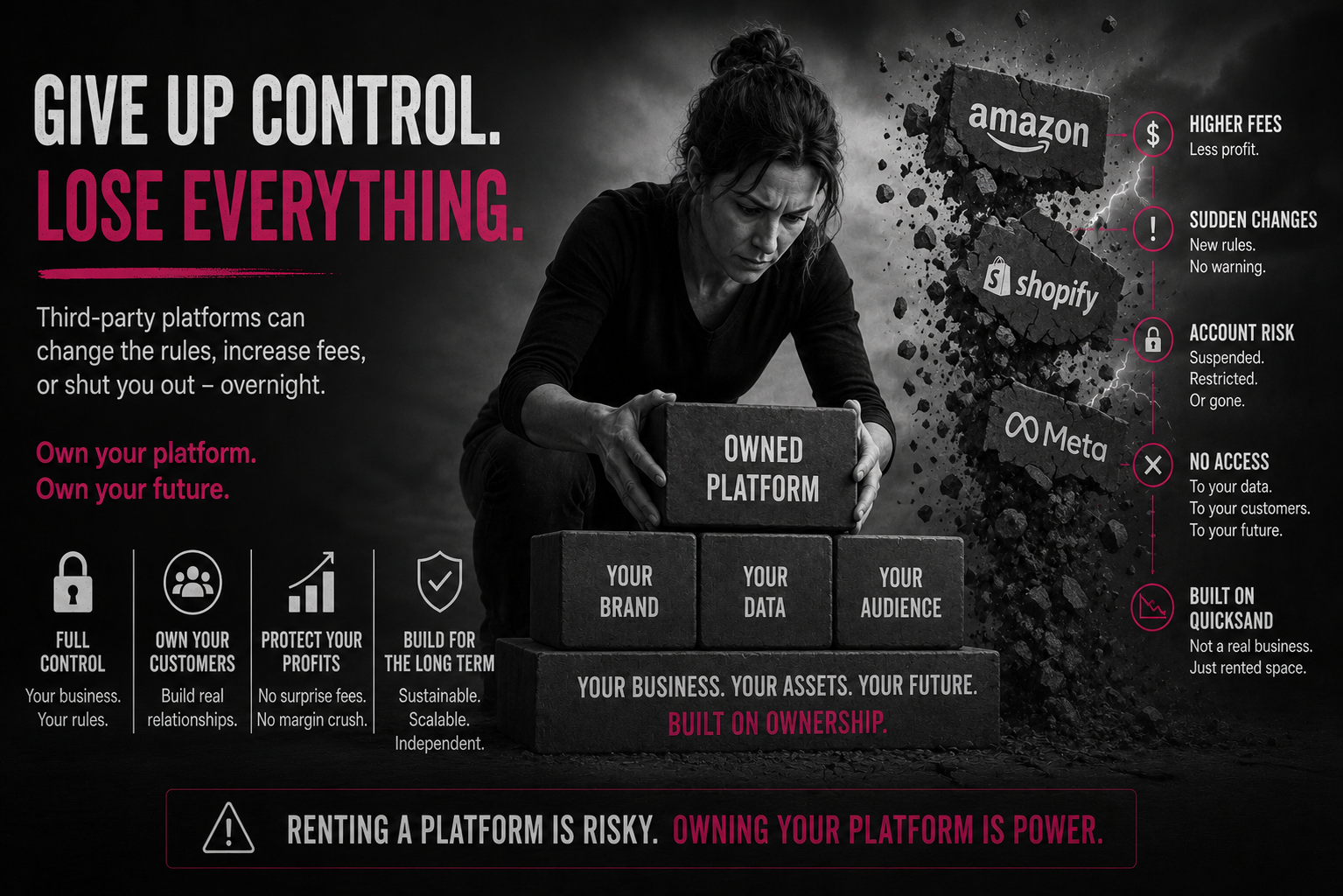
You can watch sales climb every day while becoming increasingly dependent on one marketplace, one advertising network, one algorithm or one policy change made by an executive you will never meet.
Third-party platforms and advertising networks are extraordinary tools. I still use them.
The mistake is allowing one of them to become the entire structural foundation of your business.
Assets Versus Channels
The strongest ecommerce businesses deliberately reduce unnecessary dependence.
They invest in assets that continue creating value regardless of what an external platform decides to change tomorrow morning.
- Platforms are channels. They are rented land.
- Assets are foundations. They are owned land.
Your independent website, brand positioning, customer email list, supplier relationships, content, customer data and direct market reputation are all assets.
You can carry them forward.
I still believe major marketplaces and advertising networks can play an enormous role in growing an ecommerce brand. But I no longer confuse marketplace access with business ownership.
My account eventually came back.
My rankings never did.
Control Is a Form of Margin
Control gives you room to respond when something goes wrong.
If one advertising account is suspended, you have other ways to reach customers. If one marketplace changes its rules, you still have your website, email list, brand and supplier relationships.
That is strategic margin.
It doesn’t mean avoiding platforms. It means using them without allowing them to own your entire route to the customer.
Without that painful wake-up call in France, I might never have realised that the strongest ecommerce businesses aren’t simply built for rapid growth.
They are built for resilience.
And resilience begins with control.
Your Margin Edge
Before you spend another franc, pound or dollar on advertising, ask yourself one sobering question:
If my biggest source of customers disappeared tomorrow morning, what would I still own?
- Transaction seeker: Builds revenue on rented land and leaves the business vulnerable to a single algorithmic decision.
- Founder mindset: Uses platforms as distribution channels while building owned assets, customer data and direct relationships.
Your answer reveals whether you’re building a business you control or borrowing someone else’s platform to gamble with products.
I learnt that distinction the expensive way.
You don’t have to.
Build Premium. Protect Margin. Compound.
See you next Saturday…
Rebecca
If you liked the above, you might also like:
#004. The Ecommerce Evolution: From Dropshipping to a Minimum Viable Brand
#002. Why Chasing Revenue Keeps You Broke: PROFIT Sets You Apart
#001. Build Less, Profit More: The Winning-Margin Ecommerce Model